

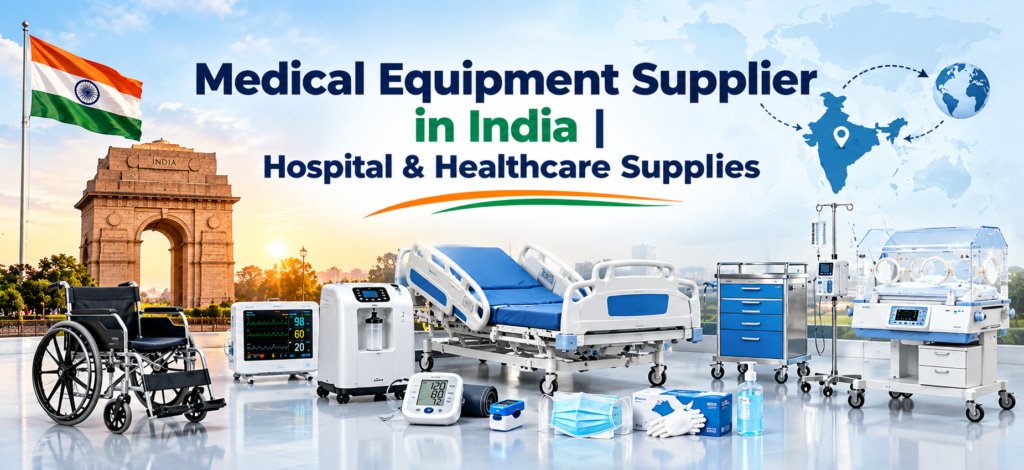
how do you choose a medical equipment supplier in India?
Choose a supplier that can show product model numbers, written specifications, valid regulatory documents (CDSCO registration or licence where the device requires it), a clear warranty, and a named after-sales contact. Compare equivalent models, not just prices, and get taxes, lead time and delivery terms in writing before you order.
What is Nimameds?
Nimameds is an online healthcare and medical supply business in India, focused on helping individuals, caregivers, healthcare professionals, and institutions find medical equipment and healthcare products.
Our product offering includes diagnostic and monitoring equipment, mobility aids, personal protective equipment (PPE), nursing supplies, and home-care essentials.
Nimameds aims to make medical product discovery and purchasing more convenient through an accessible online shopping experience and product enquiry support.
For hospitals, clinics, medical distributors, importers, and institutional procurement teams, finding suitable equipment begins with understanding the intended application, specifications, quantity, budget, and delivery requirements.
Nimameds provides an online starting point for exploring these needs.
What the law requires: medical devices in India
In India, medical devices are regulated by the Central Drugs Standard Control Organisation (CDSCO) under the Medical Devices Rules, 2017. Devices are classified by risk (Class A to D), and many commonly purchased items, including digital thermometers, blood pressure monitors, glucometers, nebulizers and pulse oximeters, fall under notified categories that need registration or a licence for manufacture or import. Always ask your supplier for the manufacturer’s or importer’s licence or registration number for each device, and check it against CDSCO records. [Verify the current status of each product category before publishing.]
Useful standards to look for in product documents:
| Standard | What it covers |
|---|---|
| ISO 13485 | Quality management system for medical device manufacturers |
| IEC 60601-1 | General electrical safety of medical electrical equipment |
| ISO 81060-2 | Clinical validation of non-invasive blood pressure monitors |
| ISO 80601-2-61 | Pulse oximeter basic safety and performance |
| IEC 60601-2-52 | Medical beds |
| ISO 7176 series | Wheelchairs |
A standard listed on a brochure is a claim. Ask for the test report or certificate that supports it.
Diagnostic and monitoring equipment: what to check
Blood pressure monitors. Upper-arm monitors are generally preferred over wrist models for accuracy. Check that the device is clinically validated (ISO 81060-2 or a recognised validation protocol), that cuff sizes match your patients, and that replacement cuffs are available. Hospitals should plan calibration checks.
Pulse oximeters. Fingertip oximeters typically state an SpO₂ accuracy of about ±2% to ±3% in the 70% to 100% range. Readings can be affected by cold fingers, nail polish, motion and skin pigmentation, so they support monitoring but do not replace clinical assessment.
Thermometers and glucometers. Confirm the measurement range, the response time, and (for glucometers) the cost and shelf life of test strips, since strips are the recurring expense.
| Device | Key specification to request | Recurring cost or accessory |
|---|---|---|
| BP monitor | Validation standard, cuff size range | Replacement cuffs, batteries |
| Pulse oximeter | SpO₂ and pulse-rate accuracy, display type | Batteries, probes (clinical models) |
| Digital thermometer | Range, accuracy, response time | Batteries, probe covers |
| Glucometer | Sample size, accuracy standard | Test strips, lancets |
Hospital beds: manual vs semi-electric vs electric
A hospital bed is chosen by the patient’s mobility, the caregiver’s workload and the room layout. Larger projects should confirm the exact configuration before ordering.
| Feature | Manual (crank) | Semi-electric | Fully electric |
|---|---|---|---|
| Adjustment | Hand cranks for backrest and knee break | Motorised backrest and knee, manual height | Motorised backrest, knee and height |
| Best for | Budget-conscious wards, short-term home care | Home care with regular caregiver | ICU-style care, long-term nursing |
| Caregiver effort | Higher | Medium | Lowest |
| Power dependence | None | Partial | Full (check backup) |
| Typical cost | Lowest | Mid | Highest |
Also check the safe working load (commonly in the range of 150 kg to 250 kg for standard beds, with bariatric models higher), side rail design, mattress size and castor locking. Ask for the stated safe working load in the spec sheet, not just the sales description.
Oxygen concentrators: 5 L/min vs 10 L/min
An oxygen concentrator draws in room air and delivers concentrated oxygen. Most home units are rated at 5 L/min or 10 L/min.
| 5 L/min concentrator | 10 L/min concentrator | |
|---|---|---|
| Typical use | Prescribed home oxygen therapy | Higher flow requirements, some clinic settings |
| Oxygen purity | Typically 87% to 96% at rated flow | Typically 87% to 96% at rated flow |
| Power draw | Lower | Higher |
| Noise and size | Generally smaller and quieter | Generally larger |
Oxygen therapy must follow a doctor’s prescription. Buyers should confirm the flow rate and purity at that flow, the presence of an oxygen-purity alarm, the service interval, and who provides repairs.
Mobility aids: wheelchairs, walkers and commode chairs
| Product | Choose it when | Check |
|---|---|---|
| Manual folding wheelchair | The user or a helper can propel it and it must travel | Seat width, weight capacity, folded size |
| Reclining or high-back wheelchair | The user needs head or trunk support | Recline mechanism, footrests |
| Electric wheelchair | Independent mobility over longer distances | Battery range, charger, turning radius |
| Walker or rollator | The user can bear weight but needs stability | Height range, brakes, weight limit |
| Commode chair | Toileting support at bedside | Stability, removable pan, height |
For institutional buyers, standardising two or three models makes maintenance and spare-part stocking simpler.
Supplier evaluation checklist
| Question to ask | Why it matters | Acceptable answer |
|---|---|---|
| Which manufacturer and model? | Prevents unbranded substitution | Named brand and model number |
| Is the device registered or licensed under the Medical Devices Rules? | Legal compliance | Registration or licence number you can check |
| What is the warranty and who services it? | Downtime cost | Written term, named service contact |
| What are taxes, freight and lead time? | True landed cost | Itemised quotation |
| What are minimum order quantity and stock? | Project planning | Quantities confirmed per item |
| What is the return or replacement policy? | Risk if defective | Written policy |
The lowest quotation is rarely the lowest cost once servicing, consumables and downtime are included.
How to request a quotation from Nimameds
- Browse the online catalogue and list the products you need.
- Note model numbers (if known), specifications and quantities.
- Add your organisation name, delivery city and country, and timeline.
- Email sales@nimameds.com or call +91 9218191605.
- Compare the quotation on specification, price, taxes, delivery, warranty and payment terms.
International enquiries
Nimameds accepts enquiries from buyers outside India. IRAN, TANZANIA, UAE, USA, ETHOPIA, MALAWI, Mozamnique, Zimbabwe, EUROP, Kazakhistan, Uzbeskitan. Whether a specific product can be supplied to a specific country depends on that country’s device registration, import permissions and labelling rules, so this is confirmed per enquiry rather than assumed. When you write, include your country, city, product list, quantities and required specifications.
Frequently asked questions
Where can I buy medical equipment online in India?
You can browse medical equipment, diagnostic devices, mobility aids and PPE at the Nimameds online store and then contact the sales team for availability, specifications and a quotation.
Do medical devices need CDSCO approval in India?
Many do. Under the Medical Devices Rules, 2017, notified device categories need registration or a licence, and the requirement depends on the device and its risk class. Ask your supplier for the licence or registration number of the manufacturer or importer.
What should a hospital check before buying a hospital bed?
Check the adjustment type (manual, semi-electric or electric), safe working load, side rails, mattress size, castor locks, warranty and service support. Confirm the exact configuration in writing for bulk orders.
What is the difference between a 5 L/min and a 10 L/min oxygen concentrator?
The number is the maximum flow rate. A 5 L/min unit suits most prescribed home therapy, while a 10 L/min unit supports higher flow needs but is larger and draws more power. Choose according to the doctor’s prescription.
Does Nimameds take bulk or wholesale orders?
Hospitals, clinics and distributors can enquire about bulk orders. Minimum quantities, pricing, stock and lead time are confirmed per product.
How do I contact Nimameds?
sales@nimameds.com, call +91 9218191605, or visit nimameds.com.
Contact Nimameds
Send your product list, quantities and delivery location to sales@nimameds.com or call +91 9218191605.
Nimameds, Office No. 826, Supernova Astralis, Plot No. 3, Sector 94, Noida, India